

A pontoon swim ladder is a specialized boarding accessory that lets swimmers and passengers climb safely from the water back onto a pontoon boat's deck. Unlike a standard dock ladder, a swim ladder for pontoon boat use is designed to handle the specific deck height, hull shape, and railing geometry of a pontoon platform. The best pontoon ladders combine corrosion-resistant aluminum or stainless steel construction with non-slip steps that extend below the waterline, making reboarding possible even for solo swimmers. If you spend any real time swimming off your boat, this piece of equipment is not optional.
What is a pontoon swim ladder and why does it matter?
A pontoon swim ladder is defined as a retractable or fixed ladder mounted to the stern, side, or deck of a pontoon boat to provide safe water-to-deck access. Industry experts regard swim ladders as essential safety equipment, not a luxury, because a swimmer who cannot reboard without assistance is a swimmer at risk. The ergonomic angles and wider steps found on modern designs prevent the unstable climbing motions common in older, narrower ladder styles.
The core function is straightforward: give every passenger a reliable way back onto the boat after swimming, tubing, or falling overboard. What separates a quality swim ladder from a cheap substitute is the depth of the bottom rung. Safe pontoon swim ladders extend 12 to 24 inches below waterline to make the first step reachable even when a swimmer is treading water. That single specification eliminates the most common reboarding failure: reaching for a step that is too high to grab.
Most ladders carry three to five steps, which accommodates the range of pontoon deck heights and typical water depths across freshwater lakes and coastal waterways. The materials matter as much as the step count. Aluminum resists corrosion well in freshwater, while 316-grade stainless steel holds up better in saltwater environments like the Intracoastal Waterway or open coastal waters near Boca Raton.
What are the main pontoon ladder types and mounting styles?
Four main mounting configurations cover nearly every pontoon layout: rear-mount, side-mount, under-deck flip-down, and front-entry. Each suits a different combination of boat design, activity type, and passenger needs.
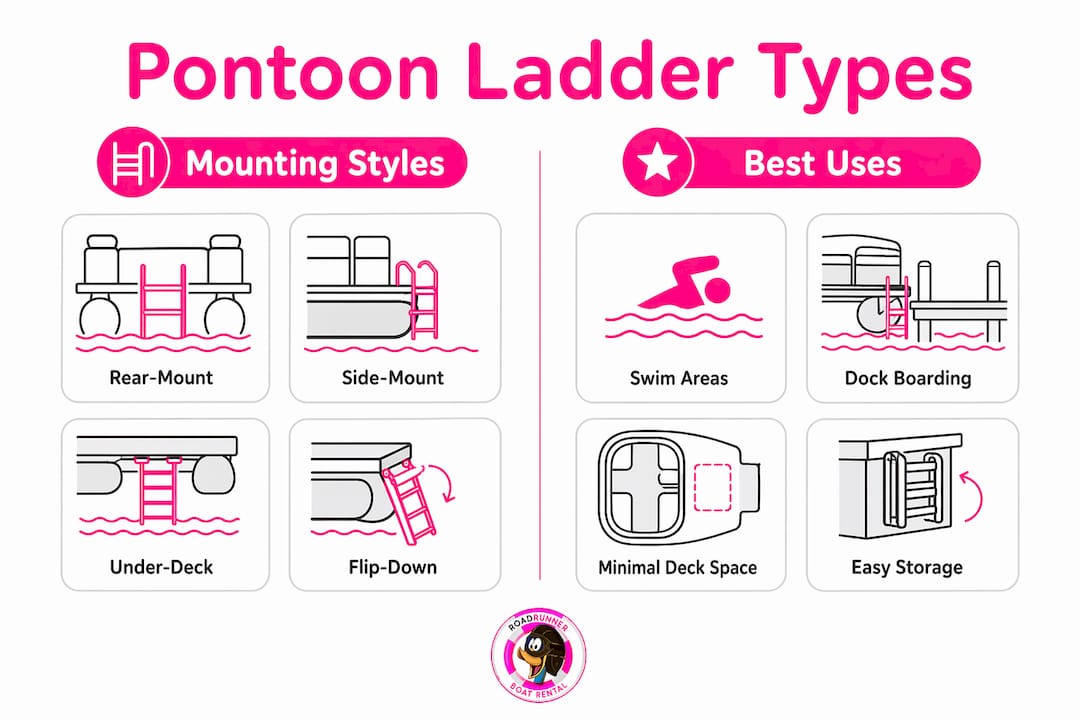
| Mounting Style | Best Use Case | Key Advantage | Main Limitation |
|---|---|---|---|
| Rear-mount | Swim areas, open water | Easy access from swim platform | Can conflict with motor placement |
| Side-mount | Dock boarding, shallow water | Dual-purpose entry and exit | Reduces usable rail space |
| Under-deck flip-down | Tight deck layouts | Stores flush, minimal obstruction | Requires clear underside clearance |
| Front-entry | Dock-side access | Ideal for slip docking | Less practical for open-water swimming |
Rear-mount ladders are the most common choice for families who anchor out and swim. They attach directly to the stern railing or transom and deploy straight down into the water. The trade-off is proximity to the outboard motor. You need to verify clearance before mounting, because a ladder that contacts the motor housing during deployment is a safety hazard and a damage risk.
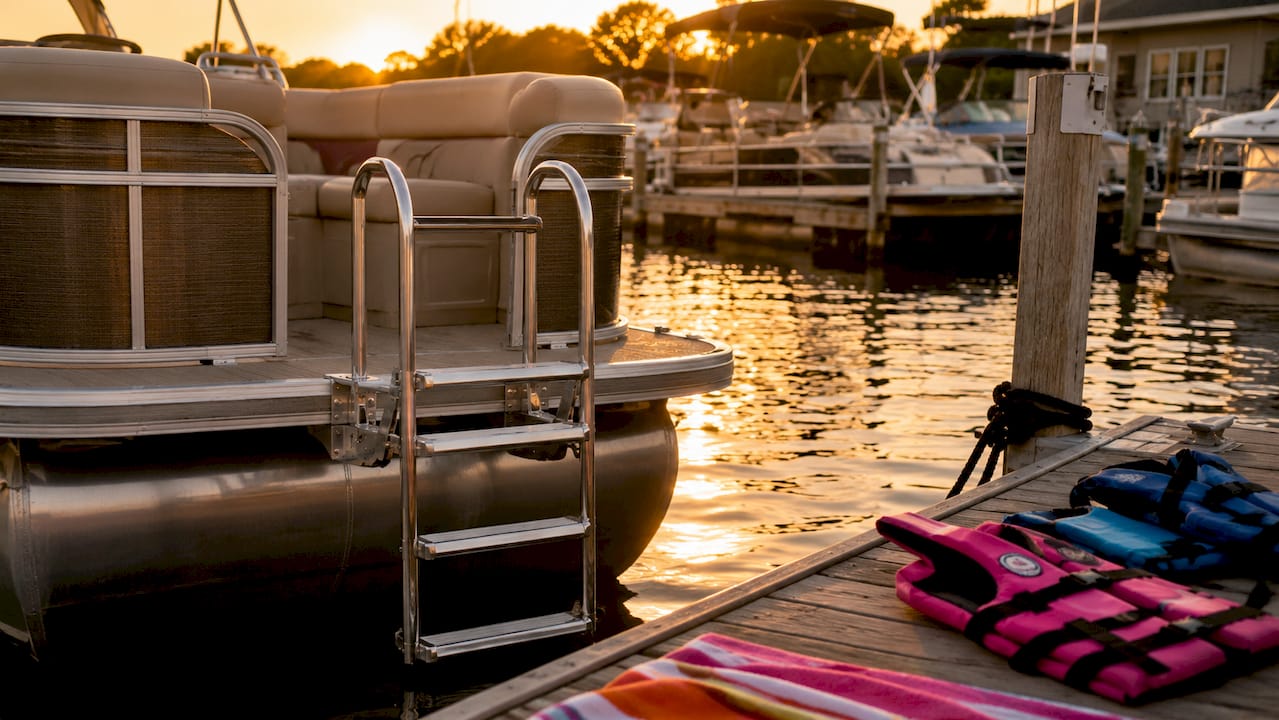
Under-deck flip-down ladders are the cleanest solution for boats with limited deck space. They fold up and sit flush against the hull when not in use. The Lippert SureStep is a well-known example of this style, offering a spring-loaded deployment mechanism that works with one hand. The limitation is that the underside of your deck must be clear of wiring, plumbing, and structural members in the mounting zone.
Side-mount and front-entry ladders serve a different primary purpose: getting on and off the boat at a dock rather than from open water. If your pontoon spends most of its time at a slip and you rarely anchor out for swimming, a side-mount near the bow gate makes boarding from a dock faster and safer for everyone, including seniors and young children.
What features define the best pontoon swim ladders?
The best pontoon ladders share a specific set of physical characteristics that separate functional safety equipment from decorative hardware. Step width is the first filter. Steps narrower than 12 inches force a swimmer to balance on the balls of their feet while climbing, which is dangerous when wet and fatigued.
Key features to prioritize when choosing a swim ladder for pontoon boat use:
- Step count: Three to five steps, with the bottom rung reaching 12 to 24 inches below the waterline for reliable first-step access
- Non-slip surface: Textured or ribbed step surfaces that maintain grip when wet, especially for barefoot users
- Handrails: Bilateral rails that extend above deck level so climbers have something to grip at the top of the ascent
- Material: Aluminum for freshwater, 316 stainless steel for saltwater or mixed environments
- Step spacing: ABYC standards require rungs spaced 12 inches apart, which matches natural climbing stride for most adults
Family-focused ladders with wider steps and non-slip surfaces enhance safety for kids, seniors, and pets in ways that narrow sport-style ladders simply cannot. A child climbing with wet hands and tired arms needs a step wide enough to plant both feet side by side.
Pro Tip: Match ladder length to your primary swimming environment. In shallow freshwater lakes, a five-step ladder may contact the bottom and bend or dislodge. A three-step model with a shorter below-waterline extension is the safer choice in water under four feet deep.
The ergonomic angle of the ladder also matters more than most buyers realize. A ladder mounted at 90 degrees to the hull forces the climber to pull straight up, which is exhausting. A ladder angled slightly away from the hull at 10 to 15 degrees lets the climber use leg drive rather than arm strength, which is critical for older passengers and children.
How to install a swim ladder on a pontoon boat
Installing a pontoon swim ladder correctly takes one to three hours depending on mounting complexity, and the process follows a clear sequence. Rushing any step, especially sealing, creates problems that are expensive to fix later.
- Choose your mounting location. Position the ladder where it clears the motor, trim tabs, and any railing hardware in both the deployed and stowed positions. Deployment clearance must be verified before drilling a single hole.
- Measure and mark. Use a level to confirm the mounting bracket sits plumb. An off-angle ladder is unstable and puts uneven stress on the mounting bolts.
- Drill pilot holes. Use a bit sized for your stainless steel bolts. Pilot holes prevent deck cracking and give you control over bolt placement.
- Seal the holes. Apply marine-grade sealant or epoxy to every hole before inserting bolts. Water intrusion leads to mounting failure over time by rotting the deck core material around the fasteners.
- Install the bracket and ladder. Thread stainless steel bolts through the bracket and deck, then add backing plates on the underside to distribute load.
- Torque bolts correctly. Snug is the target. Overtightening mounting bolts can crack the deck surface and break the sealant seal, which defeats the waterproofing entirely.
- Test stability and clearance. Deploy the ladder fully and apply body weight from multiple angles. Check that it does not contact the motor or trim in any position.
Tools required: a drill with marine-grade bits, a torque wrench or socket set, a level, marine-grade sealant (3M 5200 or equivalent), stainless steel bolts with backing plates, and a helper for the underside work.
Pro Tip: Before drilling, deploy a cardboard template of the ladder bracket and tape it to the hull. Physically move the motor through its full trim range while watching the template. This takes five minutes and prevents a costly remounting job.
Comparing swim ladders for families, sports, and casual use
Choosing a swim ladder for pontoon boat use comes down to three user profiles: families with mixed-age groups, active boaters who swim and tube frequently, and casual cruisers who board and exit at docks.
Families need wider steps, lower handrails that children can reach, and a below-waterline extension long enough for shorter-legged passengers. The Lippert SureStep addresses this with a broad step platform and a deployment mechanism that does not require strength to operate. Choosing a ladder based on deck height and passenger ability, rather than price alone, is the single most important selection principle for family boats.
| User Profile | Recommended Style | Step Width | Below-Waterline Depth | Material |
|---|---|---|---|---|
| Family with kids/seniors | Under-deck flip-down | 16+ inches | 18-24 inches | Aluminum or 316 SS |
| Active swimmers/tubers | Rear-mount fixed | 12-14 inches | 12-18 inches | 316 stainless steel |
| Casual dock cruisers | Side-mount or front-entry | 12-14 inches | 8-12 inches | Aluminum |
| Saltwater/coastal use | Rear-mount or flip-down | 14-16 inches | 12-18 inches | 316 stainless steel |
Active boaters who swim frequently in open water prioritize durability and step traction over width. Sport-style ladders with narrower steps and aggressive non-slip texturing handle repeated wet use better than wide-step family models, which can accumulate algae and grime faster in warm water.
For coastal and saltwater use near areas like Boca Raton or Pompano Beach, 316 stainless steel is the only material worth considering. Standard aluminum oxidizes in salt air within a season, while 316 SS resists chloride corrosion for years with basic rinsing after each outing. You can learn more about pontoon swim area safety to understand how ladder placement fits into the broader picture of on-water safety for groups.
Key takeaways
A pontoon swim ladder is non-negotiable safety equipment, and the right model depends on your mounting location, user profile, and water environment.
| Point | Details |
|---|---|
| Definition and purpose | A pontoon swim ladder provides safe water-to-deck access and is classified as essential safety equipment. |
| Below-waterline depth | The bottom rung should extend 12 to 24 inches below the surface for reliable reboarding access. |
| Mounting style matters | Rear-mount suits open-water swimming; under-deck flip-down suits tight decks; side-mount suits dock boarding. |
| Material selection | Use aluminum for freshwater and 316 stainless steel for saltwater or coastal environments. |
| Installation priority | Seal every bolt hole with marine-grade sealant and verify motor clearance before drilling. |
Why I always tell boaters to buy the ladder before the cup holders
Most first-time pontoon owners spend their accessory budget on Bluetooth speakers, LED lighting, and shade canopies. The swim ladder gets added as an afterthought, if at all. That is the wrong order of priorities, and I have seen it go badly.
The moment that changes a boater's thinking is usually the first time someone struggles to get back on the boat after a swim. A tired swimmer, a deck that sits 24 inches above the waterline, and a railing with nothing to grab is a genuinely dangerous combination. It is not dramatic until it is.
What I have found after years of watching people interact with pontoon boats is that the users most at risk are not strong swimmers. They are the kids who jumped in without thinking, the grandparent who slipped, and the guest who did not realize how high the deck sits. A ladder with a wide step, a handrail that clears the deck edge, and a bottom rung they can actually reach with their foot changes the outcome of every one of those situations.
The other oversight I see constantly is inadequate below-waterline extension. Boaters buy a three-step ladder, mount it, and discover the bottom rung sits six inches below the surface. A swimmer treading water cannot reach that. The 12 to 24 inch standard exists for a reason, and it is worth measuring before you buy.
Maintenance is the last thing people think about and the first thing that causes problems. Rinse your ladder with fresh water after every saltwater outing. Check the mounting bolts twice a season. Lubricate the hinge points on flip-down models annually. A ladder that seizes in the stowed position during an emergency is no ladder at all.
— Cristiano
Enjoy safe swimming on Roadrunnerboatrental's pontoon fleet
Roadrunnerboatrental equips every pontoon in its Boca Raton fleet with safe, user-friendly swim ladders designed for families, groups, and guests of all ages and abilities. Whether you are planning a sandbar trip, a birthday outing on Lake Boca, or a relaxed cruise along the Intracoastal, you board and reboard with confidence. The boats are clean, the ladders are properly mounted and tested, and the booking process is direct with no hidden fees. For a safe and enjoyable day on South Florida's waterways, reserve your pontoon with Roadrunnerboatrental and spend your time in the water, not worrying about getting back on the boat.
FAQ
What is a pontoon swim ladder used for?
A pontoon swim ladder gives swimmers and passengers a safe, stable way to climb from the water back onto the pontoon deck. It is classified as essential safety equipment because it allows solo reboarding without assistance.
How many steps should a pontoon boat ladder have?
Most pontoon swim ladders have three to five steps, with the bottom rung extending 12 to 24 inches below the waterline. The right step count depends on your deck height and the typical water depth at your swimming location.
What material is best for a saltwater pontoon ladder?
316-grade stainless steel is the best material for saltwater and coastal use because it resists chloride corrosion far better than standard aluminum. Aluminum is a practical and cost-effective choice for freshwater lakes and rivers.
How long does it take to install a pontoon swim ladder?
Installation takes one to three hours depending on the mounting style and deck construction. The most time-sensitive step is sealing bolt holes with marine-grade sealant to prevent water intrusion and long-term mounting failure.
Can I use a pontoon swim ladder to board from a dock?
Side-mount and front-entry ladders work well for dock boarding, while rear-mount ladders are optimized for open-water swimming access. Choosing the right mounting style for your primary use case determines how useful the ladder actually is day to day. For more on safe boarding practices, see how to board from a dock safely.