

Stepping onto a pontoon boat sounds simple until the boat shifts unexpectedly beneath your foot, the dock wobbles, and suddenly you're grabbing at air. It happens more often than people expect, especially for first-time renters who assume boarding is as easy as stepping off a curb. The truth is that most water-related injuries happen not during the ride but during the transition from dock to deck. This guide walks you through every stage of safe pontoon boarding, from pre-boarding preparation to final departure checks, so your time on Boca Raton's beautiful waterways starts on solid footing.
Table of Contents
- What you need before boarding: Preparation and safety essentials
- Step-by-step guide: Boarding a pontoon boat safely
- Special scenarios: Floating docks, low light, and family considerations
- Making boarding easy for kids, seniors, and anyone needing extra support
- Final checks: Secure lines, fenders, and readiness before departure
- Our perspective: Why smooth pontoon boarding is a game-changer for Boca Raton boaters
- Set sail with confidence: Start your Boca Raton boating adventure
- Frequently asked questions
Key Takeaways
| Point | Details |
|---|---|
| Wait for captain's signal | Avoid sudden weight shifts by boarding only after approval from the captain or driver. |
| Prepare dock and boat | Secure lines, clear the deck, and check lighting before anyone steps onto the boat. |
| Use safe boarding steps | Step carefully with hands on handholds, pass items first, and transfer weight calmly. |
| Adjust for special situations | Take extra precautions on floating docks, at night, and when boarding with kids or older adults. |
| Final check before departure | Inspect fenders, knot lines, and confirm all passengers are settled before leaving the dock. |
What you need before boarding: Preparation and safety essentials
With basic expectations set, let's look at how to get the dock and your crew ready for straightforward, safe boarding.
Before a single person steps onto that pontoon deck, a few key things need to be in place. Skipping this phase is where most groups run into trouble. Rushing to board while bags are flying around, kids are darting forward, and the boat is still drifting is a recipe for a bad start.
The most important rule is that the captain should brief passengers and control who boards so unexpected weight shifts don't throw anyone off balance. This isn't about being overly formal. It's about making sure everyone knows the order, the handholds, and what to expect when they step across. A quick 60-second talk before boarding prevents the kind of chaotic scramble that leads to slips.
Equally important is the physical condition of the boarding area. Deck hazards and non-slip surfaces should be checked and managed before anyone boards, especially when families with young children are involved. Wet decks, loose gear, and poor lighting are the three most common hazards at the boarding point.
Here's a quick breakdown of what needs to be ready before anyone steps aboard:
| Item | Why it matters |
|---|---|
| Dock lines secured | Prevents the boat from drifting during boarding |
| Fenders in place | Cushions the gap between dock and boat hull |
| Non-slip mats on deck | Reduces slip risk on wet or smooth surfaces |
| Handholds/rails clear | Gives passengers something solid to grip |
| Life jackets on children | Required by law and essential for safety |
| Loose items stowed | Prevents tripping hazards during transition |
| Adequate lighting | Critical for evening or early morning boardings |
Essential pre-boarding checklist:
- Confirm the boat is tied securely on both bow and stern
- Check that fenders are positioned between the hull and dock
- Lay non-slip mats at the boarding entry point
- Clear the deck of coolers, bags, or chairs near the entry
- Ensure all children have properly fitted life jackets
- Brief every passenger on the boarding sequence before starting
Pro Tip: Have one non-boarding crew member handle large items like coolers and gear bags first, loading them onto the boat before any passengers step aboard. This keeps the deck clear and reduces the chance of someone tripping while carrying something heavy.
If you're planning family-friendly boat boarding with young kids or elderly guests, preparation time is even more valuable. Think of it as the five minutes that save you from a much bigger problem.
Step-by-step guide: Boarding a pontoon boat safely
Once you're sure your crew and platform are ready, follow these steps for worry-free boarding.
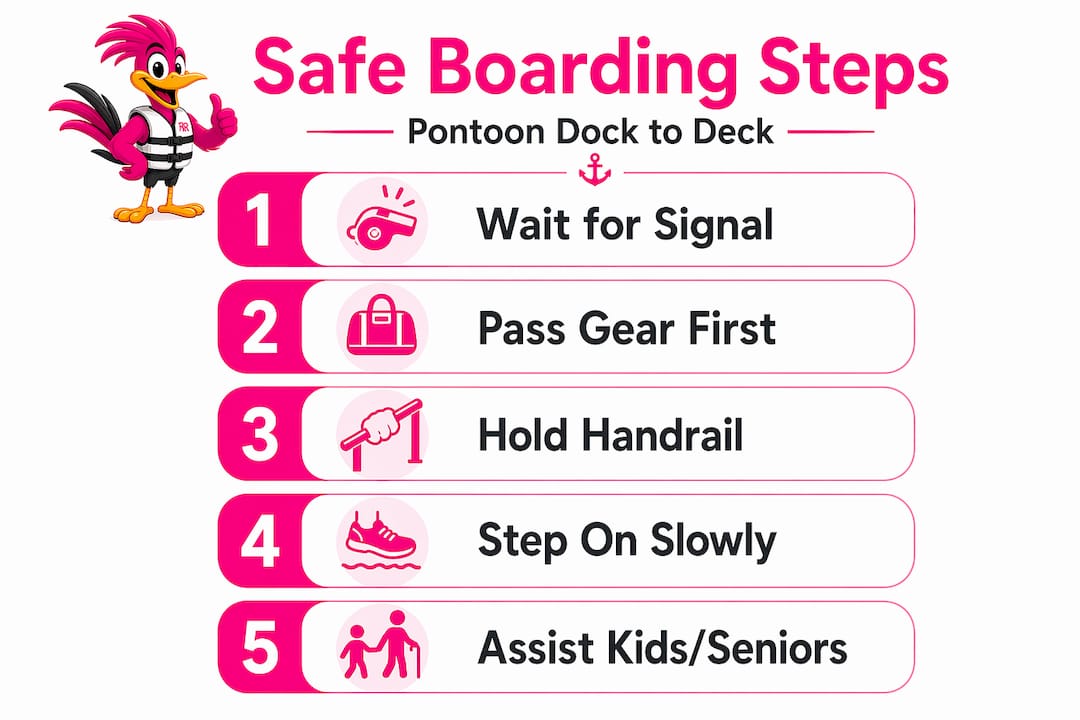
The actual boarding sequence matters a lot. Doing things in the right order keeps the boat stable and gives every passenger a safe, predictable experience. Here's the sequence that works consistently well:
- Secure the boat. Confirm dock lines are tight and the boat isn't drifting. The boat should be snug against the dock with fenders in place.
- Captain gives the all-clear. No one boards until the captain confirms the boat is stable and ready. This is non-negotiable.
- Pass items across first. Hand bags, towels, coolers, and any loose gear onto the deck before anyone steps aboard. Never carry bulky items while boarding.
- First passenger steps aboard. The most physically capable adult boards first to stabilize the boat and assist others.
- Use the one-foot method. Place one hand firmly on a railing or handhold, step one foot onto the deck, confirm it's stable, then transfer your full weight and bring the other foot across.
- Assist children and seniors. Once the first adult is aboard, they can help guide younger or older passengers across.
- Repeat in sequence. Board one person at a time. Never have two people stepping on simultaneously.
Safety warning: Only board after the captain gives explicit confirmation that the boat is secured and stable. Boarding a drifting or unsecured boat is one of the leading causes of dock-related falls.
The hand-and-foot technique is the most reliable method: keep hands free for handholds, pass items first, then place one foot securely before transferring full weight. It sounds simple, but most people instinctively grab items with both hands and try to step across at the same time. That's exactly when falls happen.
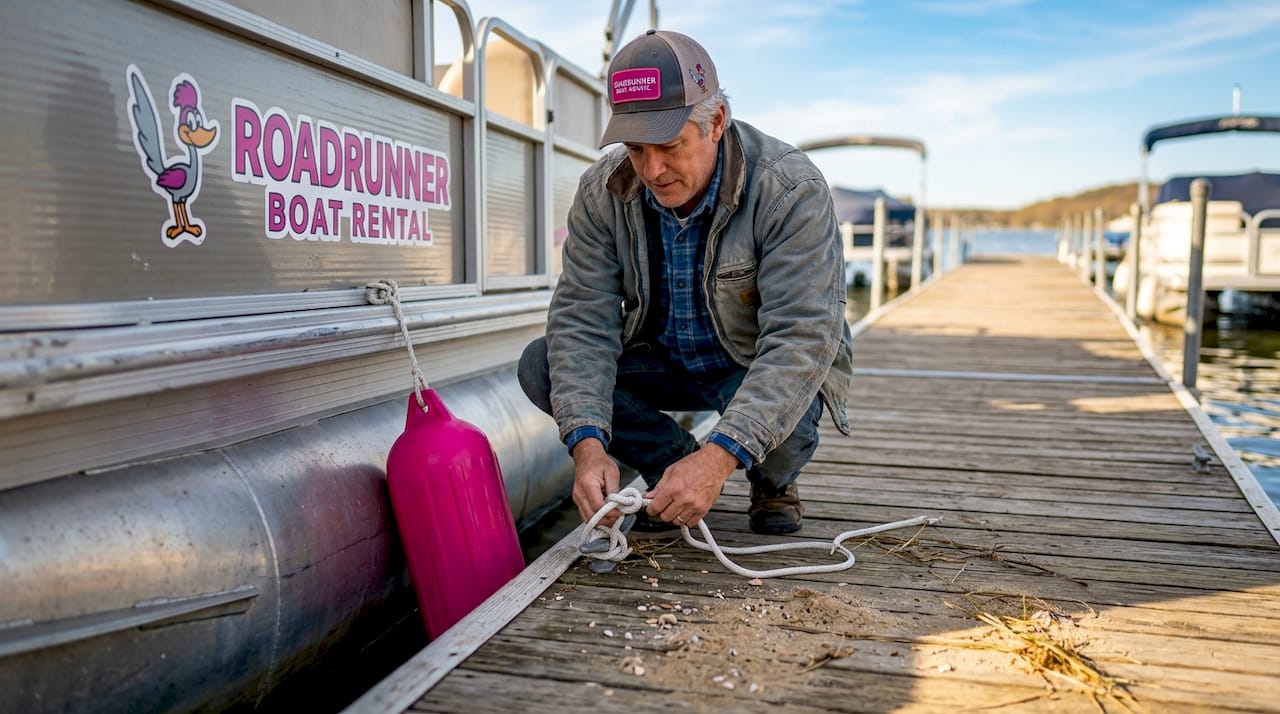
The boat also needs to be properly tied off and fendered so it stays steady throughout the entire boarding process. Even a small gap between dock and deck can widen quickly if lines aren't snug.
| Step | Common mistake to avoid |
|---|---|
| Securing the boat | Leaving lines loose or relying on just one line |
| Captain's approval | Boarding before confirmation |
| Passing items first | Carrying bags while stepping across |
| One-foot method | Jumping or stepping with both feet at once |
| Assisting others | Letting children board unsupervised |
If you're exploring Lake Boca boarding spots, the dock conditions can vary. Some spots have wider, fixed platforms while others are narrower floating docks. Knowing the sequence keeps you confident regardless of where you're launching.
Pro Tip: Assign one adult specifically to assist children and seniors at each step. That person's only job during boarding is to guide and steady others, not to carry gear or manage lines.
Special scenarios: Floating docks, low light, and family considerations
Not all docks or groups are the same; here's how to adjust for common special circumstances in Boca Raton.
Boca Raton's waterways include a mix of fixed concrete docks and floating docks that rise and fall with tides and wakes. Floating docks introduce a whole new layer of movement that catches people off guard.
Floating docks increase fall risk because motion from waves, wind, and tidal shifts constantly changes the alignment between dock and deck. What feels stable one second can shift the next. This is especially true in South Florida where boat traffic on the Intracoastal creates frequent wakes.
What to do differently on a floating dock:
- Move more slowly than you think you need to
- Wait for a moment of minimal movement before stepping across
- Grip handholds with both hands before shifting your weight
- Keep your center of gravity low by bending your knees slightly
- Never step across when the dock and boat are moving in opposite directions
- Have someone stabilize the dock from the water side if possible
Low light is another underestimated hazard. Early morning departures and sunset returns are popular in Boca Raton, and the reduced visibility at these times makes the boarding gap harder to judge. Use a portable lantern, headlamp, or even a phone flashlight to illuminate the boarding point. Make sure the pathway from the parking area to the dock is also visible.
Most accidental falls on boats happen during boarding and exiting, not during the ride itself. The transition zone between dock and deck is where attention drops and movement is most unpredictable. Treating this moment with the same care you'd give to any physical activity with real consequences keeps everyone safe.
For families, managing deck hazards and keeping kids in safe zones is essential. Children should be in properly fitted life jackets before they even approach the dock edge. Keep young children inside the rails and gates at all times once aboard.
Pro Tip: Designate one adult whose sole responsibility during boarding is watching children and mobility-limited guests. That person doesn't touch lines, gear, or anything else until every vulnerable passenger is safely aboard and seated.
When boating with kids in Boca Raton, the extra few minutes spent on careful boarding pay off enormously. A calm, organized boarding process also sets the tone for the rest of the trip.
Making boarding easy for kids, seniors, and anyone needing extra support
Everyone can board a pontoon boat confidently with the right adaptations. Let's look at simple ways to offer support.
Not every passenger is a fit adult in their thirties. Pontoon boats are popular precisely because they welcome everyone, from toddlers to grandparents. But that inclusivity only works if the boarding setup matches the needs of your group.
A quality boarding ladder makes a significant difference. The ideal ladder for kids and seniors features wide, non-slip steps, sturdy handrails on both sides, and a gentle angle of roughly 50 to 60 degrees. A ladder that's too steep forces passengers to lean forward awkwardly, which throws off balance and increases strain on the knees and hips.
Features to look for in a boarding ladder or steps:
- Wide steps with textured or rubberized surfaces
- Dual handrails that extend above the deck level
- Angle between 50 and 60 degrees for comfortable climbing
- Weight rating appropriate for your heaviest passenger
- Secure mounting so the ladder doesn't shift under load
- Steps spaced evenly so stride length is predictable
Beyond the ladder itself, simple human support goes a long way. Offer a hand or a steady arm to anyone who hesitates at the boarding point. Moving slowly is not a sign of weakness. It's the correct technique. Rushing someone who feels uncertain is how minor hesitation turns into a fall.
For passengers with limited mobility, consider positioning the boat so the boarding point aligns with the lowest part of the dock. Reducing the height difference between dock and deck, even by a few inches, makes the step significantly easier.
Pro Tip: Test the ladder angle and step grip yourself before letting children or anyone with mobility concerns use it. If the steps feel slippery or the angle feels awkward to you, they'll feel much worse to someone less confident on the water.
Family boat accessibility is something we think about carefully when setting up our boats. A great day on the water starts with everyone getting aboard comfortably and confidently.
Final checks: Secure lines, fenders, and readiness before departure
Just before you cast off, take a moment for these last checks to keep everyone and the trip safe and smooth.
Everyone is aboard. The excitement is building. But before you release those dock lines and head out onto the water, run through a final set of checks. This takes about two minutes and prevents the kind of problems that ruin an otherwise perfect day.
The boat should be tied off and fendered properly right up until the moment you're ready to depart. Don't loosen lines early. Keep the boat stable while you complete these final steps.
Pre-departure checklist:
- Walk the deck and remove any tripping hazards near seating areas
- Confirm all dock lines are still secure and fenders are in position
- Check that every child is wearing a properly fitted life jacket
- Make sure all passengers are seated or holding onto a rail
- Stow loose items like bags, shoes, and towels in storage compartments
- Confirm the pathway between seating areas is clear
- Verify that the captain has a clear view of the departure path
Once you're satisfied with each item on that list, the captain can begin the departure process. A calm, deliberate exit from the dock is just as important as a careful boarding. Sudden acceleration while passengers are still settling can cause falls just as easily as a misstep during boarding.
Our perspective: Why smooth pontoon boarding is a game-changer for Boca Raton boaters
Here's something we've noticed after watching hundreds of groups head out from local docks: the quality of the boarding experience directly shapes the mood of the entire outing. When boarding is chaotic, rushed, or stressful, that energy carries onto the water. People are flustered. Someone's annoyed. The first ten minutes of the trip are spent recovering instead of relaxing.
On the other hand, when boarding is calm, organized, and smooth, something shifts. People settle in quickly. Laughter starts early. The trip feels longer in the best possible way because everyone is present and relaxed from the very first moment.
We also think the conventional wisdom of "just be careful" is not enough. Careful is vague. What actually works is a specific sequence, a clear chain of command, and a brief but genuine briefing before anyone steps foot near the dock edge. That's not overcautious. That's just smart.
Boca Raton attracts a genuinely diverse mix of boaters. You'll see multigenerational families, groups of friends who've never been on a boat, couples celebrating anniversaries, and local regulars who know these waters well. What all of them share is that they deserve a boarding experience that matches the beauty of the destination. Our pontoon rental basics are built around this idea: the experience starts before the engine does.
The waterways here are genuinely spectacular. Lake Boca, the Intracoastal, the sandbars near Deerfield Beach. None of that is fully enjoyed if the first five minutes were stressful. Smooth boarding isn't a minor detail. It's the foundation of a great day.
Set sail with confidence: Start your Boca Raton boating adventure
If you're ready to experience safe and enjoyable boating, here's how to make your next trip a breeze.
At Roadrunner Boat Rental Boca Raton, every rental comes with a thorough walkthrough that covers exactly what we've described in this guide. Our team briefs every group on safe boarding before they leave the dock, so you're never left guessing about the right technique. We keep our boats clean, well-maintained, and stocked with the safety gear you need.
Whether you're planning a relaxed afternoon on boat rentals in Boca Raton or a full-day adventure with the whole family, we have the right boat for your group. Check out our family-friendly boat options designed with easy boarding and comfort in mind, or go ahead and book your rental directly online. No hassle, no guesswork, just a great day on the water starting from the moment you arrive at the dock.
Frequently asked questions
What's the safest way to board a pontoon boat from a dock?
Always wait for the captain's signal, keep hands free for grabbing railings, and step one foot at a time while transferring bags or children before you board.
What adjustments should I make when boarding from a floating dock?
Move slowly, wait for the dock and boat to align, and grip sturdy handholds firmly before shifting your weight across the gap.
How can seniors and kids board safely?
Use a boarding ladder with wide, non-slip steps and a gentle 50 to 60 degree angle, ask for physical assistance, and always move at a deliberate, unhurried pace.
Should I wear a life jacket when boarding a pontoon boat?
Children should always wear a life jacket during boarding, and life jacket usage for kids is a core part of any family boating safety checklist. Adults are strongly encouraged to wear one near open water.
What should I check before leaving the dock?
Confirm the boat is secured, fenders are positioned correctly, all passengers are seated or holding on, and every loose item is stowed before the captain begins departure.