

Pontoon boat orientation is defined as the running attitude of the boat's deck relative to the water surface, controlled by adjusting the outboard motor's propeller shaft angle. Most beginners hear "orientation" and think it means which direction the boat is pointed. That is a different concept entirely. What you actually need to master is boat trim, the physical angle at which your pontoon sits and moves through the water. Understanding this distinction is the foundation of safe, comfortable, and fuel-efficient boating on Lake Boca, the Intracoastal, or any South Florida waterway. If you are new to pontoon boat basics, this is where to start.
What is pontoon boat orientation and why does it matter?
Pontoon boat orientation, in the technical sense, describes the angle of the boat's deck relative to the waterline while the boat is moving. Think of it as the boat's posture. When the bow rides too high, the boat wastes fuel and loses visibility. When the bow rides too low, the hull digs in and the ride gets rough. Getting this angle right is what separates a smooth, efficient cruise from a frustrating one.
The industry term for this is trim. Trim refers to the fore-and-aft balance of the boat as it moves through the water, and it is adjusted using the outboard motor's power trim system. Every time you change speed, add passengers, or move into choppier water, the ideal trim setting shifts. A "set it and forget it" mindset is risky because conditions change constantly, and trim affects comfort, economy, and safety in ways that compound quickly.
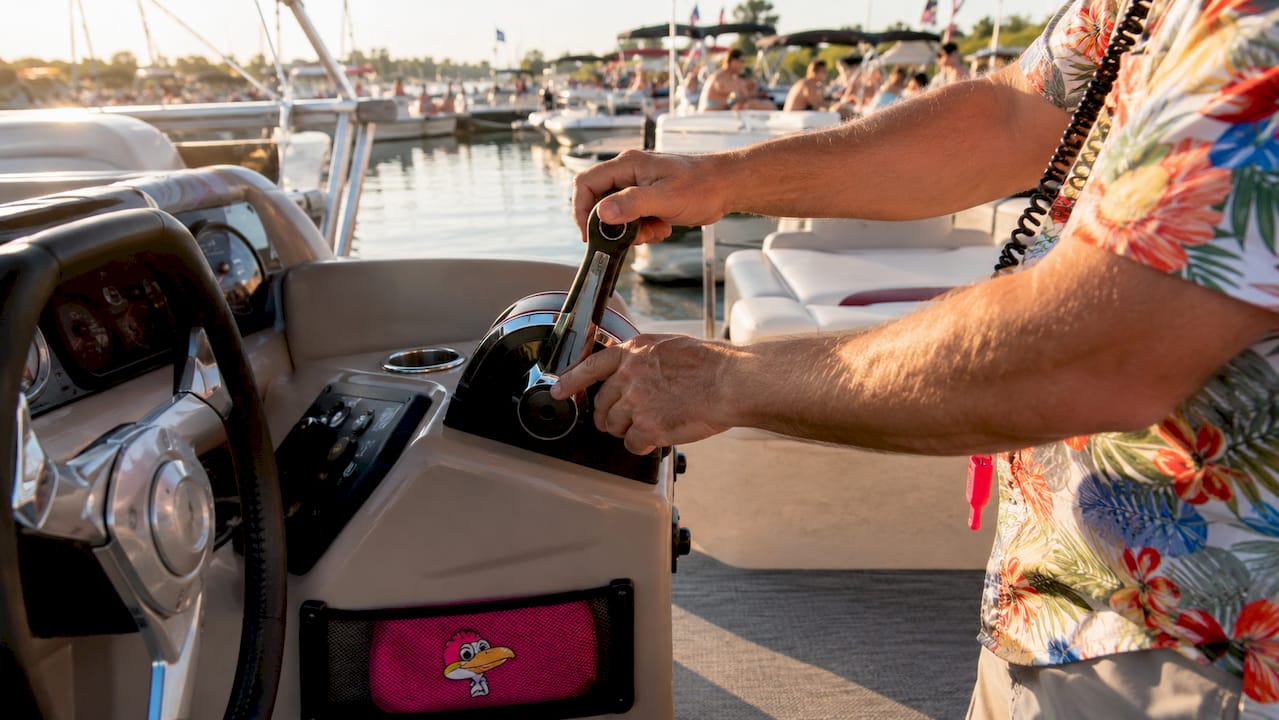
Viewing trim as the geometric deck angle relative to the waterline is the simplest way for beginners to understand what the controls actually do. Once you see it that way, the relationship between the motor angle and the bow position becomes obvious. The outboard pushes the boat forward, and the angle of the propeller shaft determines how much of that force lifts the bow versus drives it forward.
How does pontoon boat orientation affect performance and safety?
Trim directly controls four things: speed, fuel efficiency, ride comfort, and handling stability. Each one suffers when the trim is wrong, and each one improves noticeably when you find the right setting for your current conditions.
Here is what each trim position does in practice:
- Trim in (negative trim): The propeller shaft angles lower than the water surface. This increases hull contact, helps the boat get on plane faster, and is the correct starting position when accelerating from a stop. It is also the right setting for heavy loads or rough water.
- Zero trim (neutral): The propeller shaft runs parallel to the water surface. This is a stable mid-point that works well at moderate speeds on calm water.
- Trim out (positive trim): The bow rises, reducing hull contact and drag. At cruising speed, this setting improves fuel efficiency and top-end speed. However, over-trimming causes porpoising, a rhythmic bow bounce that is uncomfortable and hard to control.
- The sweet spot: A trim position where the bow sits just slightly elevated, the ride is smooth, and the engine sounds settled. This is what you are always hunting for.
Safety is directly tied to trim as well. A bow that rides too high blocks your forward sightline, which is a serious hazard at speed. In shallow water, trimming the motor up reduces the risk of the propeller striking the bottom. Motor Boat & Yachting notes that trim can also be adjusted side to side using trim tabs, which corrects listing caused by uneven passenger weight.
Pro Tip: Adjust trim in small increments of two to three seconds at a time. Large, sudden changes make it harder to identify what setting actually improved the ride.
What controls adjust pontoon boat orientation and how do they work?
Understanding the controls is the next step after grasping the concept. Here is how the trim system works on a typical pontoon boat with an outboard motor:
- Locate the trim buttons. The trim up and trim down buttons are typically located near the throttle on the steering console. Some outboards also have a second set of buttons on the motor itself, useful when docking or adjusting at idle.
- Check the trim gauge. Most pontoon consoles include a trim gauge, a small dial or digital readout that shows the current trim angle. It gives you a reference point, but do not rely on it exclusively. Boat feel and bow behavior are more reliable indicators.
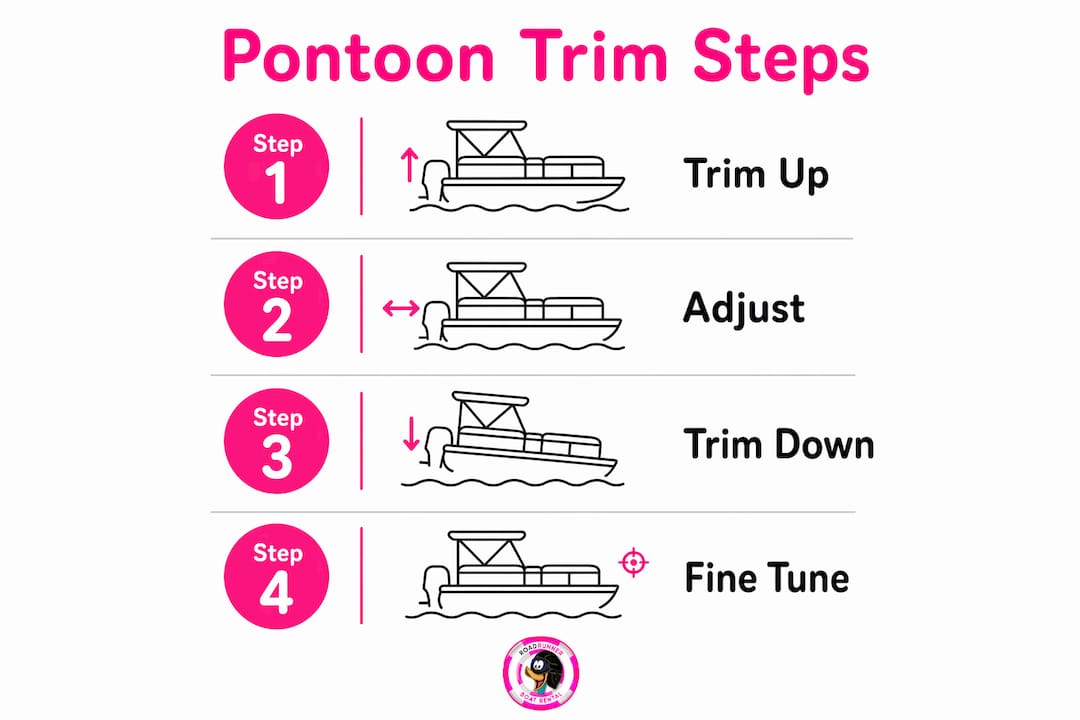
- Press trim down to start. Before accelerating, press the trim down button until the motor is at its lowest angle. This is negative trim, and it gives the boat the best grip on the water for getting on plane.
- Accelerate to cruising speed. Once the boat is moving and on plane, the bow will naturally level out. This is the moment to begin trimming out.
- Trim out gradually. Press the trim up button in short bursts and observe the bow. The ride should smooth out and speed should increase slightly. Stop trimming the moment the bow starts to bounce or the motor sounds strained.
- Adjust for conditions. Heavier loads require more trim in. Choppy water calls for a lower bow angle. Calm, flat water at speed rewards more trim out.
Trim up and down buttons change the outboard's lower-unit angle relative to the transom while the boat is underway, which is what makes real-time adjustment possible. You do not need to stop the boat to change your trim setting.
Pro Tip: Practice trim adjustments on calm, flat water before heading into open water or busy channels. Isolating trim from throttle and steering changes helps you learn what each setting actually feels like.
How to orient your pontoon boat correctly: steps and best practices
Correct pontoon boat setup for any outing follows a repeatable process. Here is the full sequence from launch to cruising:
- Start with trim fully down. At the dock or before accelerating, set the motor to its lowest trim position. This prepares the boat to get on plane efficiently.
- Accelerate smoothly. Apply throttle steadily. The bow will rise initially, then settle as the boat climbs onto plane. Do not trim out during this phase.
- Confirm you are on plane. The boat should feel light and fast, with the bow sitting level or slightly elevated. Engine RPM will stabilize.
- Begin trimming out. Press the trim up button in two-second bursts. Watch the bow and listen to the motor. The goal is a slight bow rise with no porpoising.
- Observe and adjust. Boat feel and visual cues confirm correct trim far better than gauge readings alone. If the ride gets rougher or the bow bounces, trim back in immediately.
- Re-trim when conditions change. Slowing down, adding passengers, or hitting chop all require a trim adjustment. Treat trim as an ongoing task, not a one-time setting.
For shallow water, always trim the motor up before entering to protect the propeller. Wind also affects pontoon boat positioning. A strong headwind pushes the bow down, so you may need slightly more trim out to compensate. A tailwind does the opposite.
Pro Tip: When learning, ask a passenger to watch the bow from the front seating area and call out changes. Two sets of eyes catch trim problems faster than one.
Common misconceptions about pontoon boat orientation and navigation terms
Many beginners confuse orientation as directional heading rather than the boat's running attitude, and this distinction matters for safe operation. Trim and heading are two separate systems that you manage independently.
Here is a quick reference for the navigation terms every new boater needs:
| Term | Meaning |
|---|---|
| Bow | The front of the boat |
| Stern | The back of the boat |
| Port | The left side when facing forward |
| Starboard | The right side when facing forward |
| Fore | Toward the front of the boat |
| Aft | Toward the back of the boat |
These nautical direction terms describe where things are located or which way the boat is pointed. Trim describes the physical angle of the deck as the boat moves. Both matter, and confusing them leads to real handling errors.
A few common misconceptions worth clearing up:
- "Orientation means which way I'm pointed." Heading is direction. Orientation, in the trim sense, is the deck angle relative to the water.
- "I only need to trim once per trip." Conditions change constantly. Trim is an active, ongoing adjustment.
- "The trim gauge tells me everything." Gauges give a reference. Bow behavior and boat feel are the real feedback.
- "Trimming up always makes the boat faster." Too much trim out causes porpoising and actually slows the boat while making it harder to control.
Practicing safe pontoon boat handling means getting comfortable with both trim and directional awareness at the same time. The two skills reinforce each other once you have time on the water.
Key takeaways
Correct pontoon boat orientation requires understanding trim as the deck's running angle, using the outboard's power trim controls actively, and adjusting continuously as speed, load, and water conditions change.
| Point | Details |
|---|---|
| Trim is the core concept | Pontoon boat orientation means the deck angle relative to the waterline, not the direction of travel. |
| Start trim down, then adjust | Begin every run with negative trim, get on plane, then trim out gradually to find the sweet spot. |
| Feel beats gauges | Bow behavior and boat feel confirm correct trim more reliably than the trim gauge alone. |
| Conditions demand re-trimming | Speed changes, passenger load, and chop all require a fresh trim adjustment. |
| Navigation terms are separate | Bow, stern, port, and starboard describe position and heading, not the boat's running attitude. |
What I've learned from watching new boaters trim for the first time
Most first-timers grip the throttle and forget the trim buttons exist. I get it. There is already a lot happening when you are learning to steer, watch for traffic, and manage speed at the same time. But trim is the control that makes everything else easier, and ignoring it means working harder for a worse ride.
What I have noticed is that the biggest improvement comes not from knowing the theory but from feeling the boat respond. The first time a new boater trims out on flat water and the bow settles into that smooth, effortless glide, something clicks. They stop thinking about it as a technical adjustment and start treating it as a natural part of driving the boat.
My honest advice: do not practice trim in busy channels or open water on your first outing. Find a calm stretch, get on plane, and spend five minutes just pressing the trim button up and down while keeping speed constant. You will feel the difference between too much, too little, and just right within a few tries. That physical memory is worth more than any amount of reading.
The other thing I would say is that trim confidence builds boarding and docking confidence too. When you understand how the boat's attitude changes with motor angle, you start reading the water differently. You notice how a loaded boat sits differently at the dock, and you adjust before you even leave. That kind of awareness is what separates a nervous first-timer from someone who looks like they have been doing this for years.
— Cristiano
Practice your trim skills on the water with Roadrunnerboatrental
The fastest way to build real trim confidence is time on the water, and Roadrunnerboatrental makes that easy in Boca Raton and across South Florida.
Roadrunnerboatrental offers clean, reliable pontoon boat rentals in Boca Raton on Lake Boca and the Intracoastal, giving you the perfect low-pressure environment to practice orientation adjustments firsthand. The calm, protected waters around Lake Boca are ideal for beginners working on trim, positioning, and boat handling without the stress of heavy traffic or open ocean conditions. Whether you are planning a family outing or just want to build your skills, you can book your rental directly online with no hassle. Roadrunnerboatrental keeps the process simple so you spend more time on the water and less time on paperwork.
FAQ
What is pontoon boat orientation in simple terms?
Pontoon boat orientation refers to the running attitude of the boat's deck relative to the water surface, controlled by adjusting the outboard motor's trim angle. Most boaters know this concept as "trim."
What is the difference between trim and heading on a pontoon boat?
Trim describes the physical deck angle as the boat moves through water, while heading describes the direction the boat is pointed. They are adjusted independently using separate controls.
How do I know if my pontoon boat trim is set correctly?
The bow should sit slightly elevated with no bouncing or porpoising, the ride should feel smooth, and engine RPM should be stable. Bow behavior is a more reliable indicator than the trim gauge.
When should I trim my pontoon boat down versus up?
Trim down when accelerating from a stop, carrying heavy loads, or operating in rough water. Trim up gradually once the boat is on plane and cruising at speed on calm water.
Can wrong trim damage a pontoon boat?
Sustained over-trimming can strain the motor and cause porpoising, which stresses the hull and reduces control. In shallow water, failing to trim the motor up risks propeller damage on the bottom.